
Delhi property registration

Property registration in Delhi is a critical step in securing legal ownership of real estate, ensuring transparency and protection against future disputes. Governed by the Indian Registration Act, 1908, and administered by the Sub-Registrar offices across the city, the process involves verification of documents, payment of stamp duty and registration fees, and recording of the transaction.
With property values rising and urbanization accelerating, understanding the intricacies of Delhi’s registration system is vital for buyers, sellers, and investors. Recent digitization efforts, including online submission and appointment systems, have streamlined procedures, improving accessibility and reducing delays in the real estate market.
Understanding Delhi Property Registration: A Comprehensive Guide
Property registration in Delhi is a vital legal process that ensures the legitimacy, ownership, and secure transfer of real estate. It plays a crucial role in protecting the buyer’s rights and helps prevent future disputes over property claims.
Under the provisions of the Indian Registration Act, 1908, the registration of property is mandatory for all transactions involving the sale, gift, or mortgage of immovable property valued at ₹100 or more. In Delhi, the Department of Revenue, through the Sub-Registrar Offices located across various zones, oversees this process.
The registration validates the execution of the sale deed or agreement and officially records the buyer’s name in government land records. With digitization efforts intensifying in recent years, the Delhi government has introduced online services such as e-Stamping and e-Registration, making the entire procedure more transparent, efficient, and accessible to residents across the National Capital Territory.
Documents Required for Property Registration in Delhi
To successfully register a property in Delhi, several key documents must be submitted to the Sub-Registrar's office.
These include the original sale deed, copy of the PAN card of both buyer and seller, identity proofs, address proofs, and a registered development agreement (if applicable). Additionally, the latest property tax receipt, mutation letter, and a no-objection certificate (NOC) from relevant authorities (such as the Delhi Development Authority or housing society) are mandatory.
A khata certificate and property card may also be required to establish ownership history and land use classification. For flats, the approved building plan and completion certificate might be needed to prove legal construction. The submission of accurate and authentic paperwork is essential to avoid delays or rejection during registration.
| Document | Purpose | Mandatory? |
|---|---|---|
| Sale Deed | Legally transfers ownership from seller to buyer | Yes |
| PAN Card | Tax identification for buyer and seller | Yes |
| e-Stamp Duty Payment Proof | Confirms payment of required stamp duty | Yes |
| Ownership Proof (e.g., Title Deed) | Establishes clear title of the seller | Yes |
| Property Tax Receipt | Confirms up-to-date tax payments | Yes |
Stamp Duty and Registration Charges in Delhi
One of the most critical aspects of property registration in Delhi is the payment of stamp duty and registration fees, which are determined by the Delhi Government’s Stamp Duty Ready Reckoner. As of recent guidelines, stamp duty for general male buyers is set at 6% of the property’s market value or the agreement value, whichever is higher.
For female property owners, the rate is concessionary at 4%, encouraging women's property ownership. The registration fee is uniformly 1% of the property value, capped at ₹30,000. These charges can be paid online via the Delhi e-District portal or at authorized banks and post offices using e-Stamping.
It's important to note that underpayment or evasion of stamp duty is a punishable offense under the Indian Stamp Act, 1899, and can lead to penalties or legal complications. Accurate valuation using the Circle Rate (also known as Guidance Value) notified by the government is essential to calculate the correct duty.
Steps Involved in the Online Property Registration Process
The Government of Delhi has streamlined the registration process through its online e-Registration system, reducing paperwork and waiting times. The first step involves appointment booking through the official e-District Delhi portal, where applicants select a convenient Sub-Registrar office and time slot.
Next, the parties must undergo identity verification and document uploading, including the sale deed and proof of stamp duty payment. Once documents are submitted, a video-based verification is conducted involving the buyer, seller, and witnesses through a secured online platform.
After successful verification, the documents are digitally registered, and the registered sale deed is delivered electronically. This online mechanism ensures transparency, minimizes corruption, and enhances access for individuals who cannot appear in person due to health or geographical constraints. The entire process promotes digital empowerment and aligns with Delhi’s Smart City initiatives.
Step-by-Step Guide to Property Registration in Delhi
How to Register Property in Delhi: A Complete Guide to Delhi Property Registration
Understanding the Property Registration Process in Delhi
Registering a property in Delhi is a legal requirement that ensures the transfer of ownership from the seller to the buyer is officially recorded. The process is governed by the Indian Registration Act, 1908, and must be completed within four months from the date of execution of the sale deed.
Failing to register a property can lead to legal complications and the document may not be admissible as evidence in court. The registration process involves verification of property documents, payment of stamp duty and registration fees, and submission of the deed to the Sub-Registrar's Office.
It is essential that the buyer personally appears at the sub-registrar’s office with the seller and witnesses to complete the process. The property registration not only provides legal protection but also serves as a public record confirming ownership.
- Identify the correct Sub-Registrar Office based on the property’s location in Delhi.
- Ensure all title documents of the property are verified by a licensed advocate.
- Complete a sale agreement outlining all terms and conditions agreed upon by buyer and seller.
- Get the property market value assessed to calculate exact stamp duty liability.
- Pay the prescribed stamp duty and registration charges as per Delhi government rates.
Required Documents for Property Registration in Delhi
To successfully register a property in Delhi, several documents must be submitted to the Sub-Registrar Office. These documents are crucial for establishing ownership, verifying the legal status of the property, and ensuring the transaction is compliant with state laws.
The absence of any required document may lead to rejection or delays in the registration process. It is recommended to make both original and self-attested photocopies of all documents. Additionally, all parties involved—buyer, seller, and witnesses—must carry valid photo identification proof.
- Sale deed or purchase agreement signed by both parties.
- Original sale deed and previous chain of title deeds for property verification.
- NOC from the Delhi Development Authority (DDA) or relevant housing board, if applicable.
- Up-to-date property tax receipts and utility bills (electricity, water).
- Identity and address proof of buyer, seller, and at least two witnesses (Aadhaar, PAN, passport, etc.).
- Stamp duty payment receipt and challan from the authorized bank or online portal.
- Encumbrance certificate to confirm no legal disputes or loans are attached to the property.
Step-by-Step Guide to Property Registration Fees and Payment
The payment of stamp duty and registration charges is a critical component of the property registration process in Delhi. These fees are determined based on the property’s market value as estimated by the Stamp Duty Ready Reckoner, a valuation tool provided by the Delhi Government. The standard registration fee in Delhi is 1% of the market value, subject to a maximum cap.
Stamp duty rates vary depending on the property type, location, and gender of the buyer—women buyers often receive a discounted rate as part of government incentives. Payments can now be made online via the IGR Delhi (Inspector General of Registration) portal or at designated banks.
- Determine the market value of the property using the Ready Reckoner rate applicable in the respective zone.
- Calculate stamp duty: 6% for male buyers and 4% for female buyers in most residential cases (subject to change).
- Calculate 1% of the property value for registration charges (maximum Rs. 30,000).
- Visit the official IGR Delhi website or designated bank to pay stamp duty and registration fees online.
- Generate and retain payment challan and acknowledgment as proof of payment.
- Submit the payment receipt along with other documents during the registration appointment at the sub-registrar’s office.
How to verify property ownership details in Delhi through registration records?
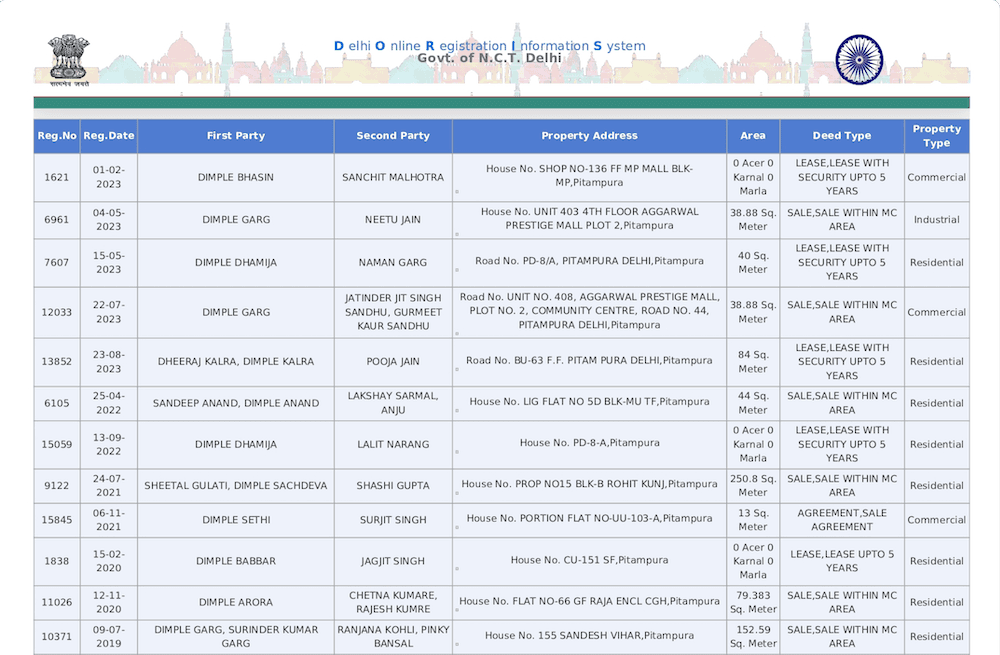
Accessing Property Registration Records Online via DRO Portal
- Visit the official website of the Delhi Registration Department, known as the DRO (Delhi Registrar Office) portal, which is managed by the Department of Revenue, Government of NCT of Delhi. The portal provides online access to property registration data for public verification.
- Use the Search Document or Citizen Services section on the portal. You will need specific details such as the registration number, date of registration, names of the parties involved, or the property’s location details including the sub-registrar office and area name.
- After entering the required information, the system will retrieve the relevant registration documents. These documents include the full deed, such as sale, gift, or conveyance deed, which clearly states the names and addresses of both buyer and seller, property description, and the date of registration, enabling verification of ownership.
Visiting the Sub-Registrar Office for Physical Verification
- Locate the specific Sub-Registrar Office where the property was registered. Each area in Delhi falls under a designated sub-registrar jurisdiction, and records are maintained at the local office. This information can be obtained using the property address or through the DRO portal.
- Visit the office during working hours with valid identification and documents such as the property’s registration number or a copy of the sale deed, if available. Request a certified copy of the registration deed from the office records.
- The sub-registrar staff will assist in searching the document in their physical or digitized records. Once located, you can obtain a certified copy of the deed, which legally confirms the current owner and past transaction history of the property.
Engaging a Licensed Property Lawyer or Sub-Broker for Verification
- Hire a qualified property lawyer who is familiar with Delhi’s land and registration laws. The lawyer can conduct a comprehensive title search by analyzing not just the latest registration record, but also previous deeds and encumbrance certificates to ensure there are no legal disputes or liens.
- Alternatively, enlist the help of a licensed sub-broker registered under the Delhi RERA (Real Estate Regulatory Authority) who has access to official databases and local knowledge of property records. They can assist in collecting and interpreting registration details accurately.
- The legal or authorized professional will cross-verify the ownership by checking for executed sale deeds, mutation entries in municipal records, and verifying the identity and authenticity of the seller, thereby providing a thorough and reliable validation of property ownership through registered documents.
What are the current residential property registration charges in Delhi?
Current Residential Property Registration Charges in Delhi
As of the latest regulations, the residential property registration charges in Delhi are primarily determined by the guidance value of the property and the gender of the property owner.
The registration fee is typically 6% of the property’s market value or the guidance value, whichever is higher. For male owners, the stamp duty is 6%, while for female owners, it is reduced to 4%, encouraging women's property ownership.
In cases of joint ownership between a man and a woman, the applicable stamp duty is 5%. These charges are governed by the Delhi Stamp Act and are subject to periodic revisions based on government policy. It is essential to ensure that all transactions are registered with the Sub-Registrar Office to establish legal ownership.
- Registration fee is 6% of the higher of market or guidance value for male applicants.
- Female property owners benefit from a reduced stamp duty rate of 4%.
- Joint ownership with at least one woman attracts a moderate 5% stamp duty rate.
Factors Influencing Property Registration Costs in Delhi
Several factors impact the total cost of registering a residential property in Delhi. The primary determinant is the guidance value, which varies significantly by locality and is updated periodically by the Delhi government.
The actual transaction value, property type, and ownership status also contribute to the final charge. Additionally, properties located in prime areas such as South Delhi or central zones generally have higher guidance values, resulting in increased registration costs.
Encumbrance certificates and proper property documentation play a role in streamlining the process and avoiding delays. Buyers are also advised to consult the latest circle rates published by the sub-registrar to estimate payable charges accurately.
- Guidance value, fixed by the government, significantly affects registration cost.
- Location-specific circle rates lead to variations across different parts of Delhi.
- Accurate and legally sound documentation ensures a smooth registration process.
Documents Required for Property Registration in Delhi
To initiate property registration in Delhi, a set of essential documents must be submitted to the Sub-Registrar Office. These include the sale deed, identity proof of both buyer and seller, proof of property ownership, NOC from relevant authorities (if applicable), and the latest property tax receipts.
An approved property plan and sale agreement are also required to validate the transaction. In addition, PAN cards of both parties are mandatory for transactions exceeding ₹50 lakh. The verification of these documents ensures the legality and authenticity of the property transfer. It is also advisable to conduct a land title search to prevent future legal disputes.
- Sale deed and sale agreement are foundational legal documents for registration.
- Valid photo ID proofs and PAN cards for parties involved are compulsory.
- Up-to-date property tax receipts and approved building plans ensure compliance.
Why is property registration suspended in Delhi?
Legal and Judicial Intervention
- The suspension of property registration in Delhi is primarily due to a judicial order issued by the Delhi High Court, which raised concerns over alleged irregularities and unauthorized changes in land use classifications.
- The court intervened after multiple petitions highlighted procedural violations in the conversion of agricultural and institutional land into commercial or residential plots without proper approvals.
- This legal scrutiny has led to a temporary halt in registration processes to allow authorities to verify the legitimacy of pending property transactions and ensure compliance with urban development regulations.
Impact of Land Use Classification Disputes
- One of the major underlying issues is the ongoing dispute regarding land use zoning, particularly involving lands marked for public purposes like schools, hospitals, or green belts being used for private real estate development.
- Unauthorized constructions and land conversions have prompted regulatory bodies to suspend registrations to prevent the legalization of properties that may violate the Master Plan of Delhi (MPD) 2041.
- The suspension allows the Delhi Development Authority (DDA) and other agencies to conduct audits and resolve conflicting claims over land ownership and usage rights before resuming normal operations.
Administrative and Regulatory Oversight
- The Department of Revenue in the Government of NCT of Delhi implemented the suspension to strengthen regulatory oversight and prevent potential fraud in property dealings.
- During this period, Sub-Registrars across various districts have been instructed to withhold registration of deeds until further directives are issued, affecting both residential and commercial property transactions.
- This pause is also intended to allow time for updating digital land records and integrating them with the Bhoomi Rashi portal, a national land record management system aimed at increasing transparency and reducing documentation errors.
Frequently Asked Questions
What is the process for property registration in Delhi?
Property registration in Delhi involves verifying the title deed, paying stamp duty and registration fees, and submitting documents at the Sub-Registrar Office. Required documents include sale deed, identity proof, and property ID. The buyer and seller must be present with two witnesses. After verification, the property details are recorded in the sub-registrar’s records, and a registration certificate is issued, confirming legal ownership transfer.
How much does it cost to register a property in Delhi?
The cost of property registration in Delhi includes stamp duty and registration fees. Stamp duty is 6% for men, 4% for women, and 5% for joint ownership under the general category. Registration fees are 1% of the property value or ₹30,000, whichever is lower. Additional charges may apply for document verification and processing. These costs are payable in demand draft or online payment at the Sub-Registrar Office.
What documents are required for property registration in Delhi?
Required documents for property registration in Delhi include the signed sale deed, identity proofs of buyer and seller, property cards, approved building plans, NOC from relevant authorities (like DDA or MCD), and stamp duty payment proof. Pan cards, Aadhaar cards, and two witnesses with ID proofs are also mandatory. All documents must be original and accompanied by photocopies for verification during registration at the Sub-Registrar Office.
Can property registration in Delhi be done online?
Yes, property registration in Delhi can be initiated online through the Delhi e-District portal. Parties can book appointments, pay stamp duty, and submit scanned documents electronically. However, biometric verification and document attestation require physical presence at the Sub-Registrar Office. Online submission simplifies the process but does not eliminate the need for in-person verification to complete the registration legally and securely.
Leave a Reply